la noue, montreuil and bagnolet · facades, mosaics, reliefsaugust 2026
pass it on / image education
image and media education
making your own images to learn how to read everyone else’s
At mOst, image education happens through practice. In Point de vue workshops, participatory documentaries and residencies, children, young people and adults from working-class neighborhoods photograph, film, record and write about where they live. By making their own images, they learn to read everyone else’s.
These neighborhoods are often described from the outside, through images that reduce them. Our workshops don’t set out to “give people a voice”: they create the conditions for participants to choose their subjects, their framing, their captions and how their stories will be shown.
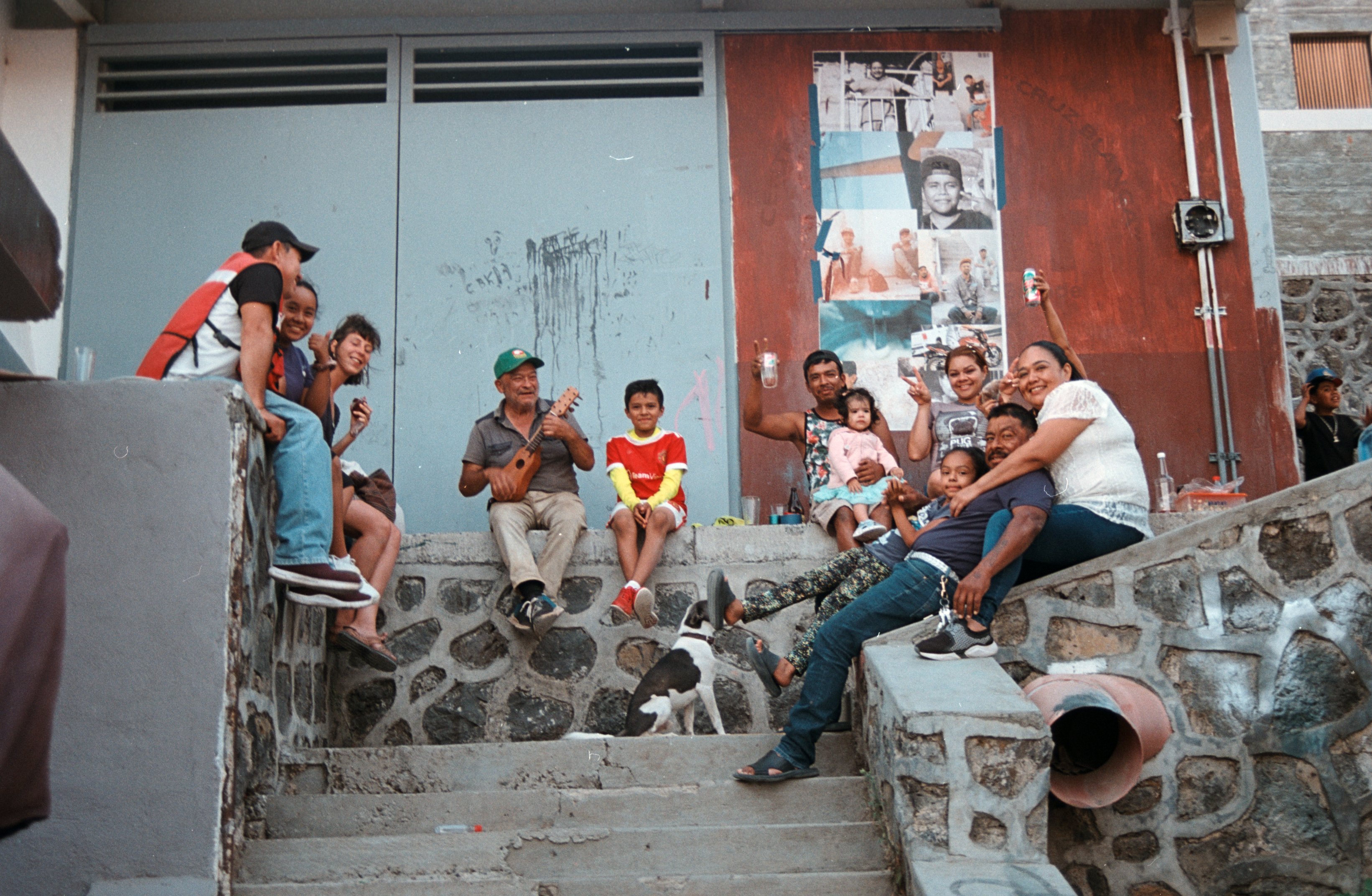
“la calle más chingona de jalisco,” ciudad guzmán, 2023
learning to see by making
Holding a camera, a video camera or a microphone means making choices. What do we show? What do we leave out of frame? What does a caption change in how a photograph is read? How does editing steer a story? In our photo, video and sound workshops, these questions come out of the act itself, before the group talks them through.
Sessions alternate between shooting, watching together and choosing. Participants sort their images, discard some, keep others and give them titles. That is where critical image reading takes shape: by understanding from the inside that an image is always made, situated and chosen.
an inquiry into your own neighborhood
Our image education workshops start from a real place: the neighborhood, the housing estate, the plaza, the school. We walk, draw a sensory map, interview neighbors in vox pops and gather the memories of older residents. Photography, video, sound, writing and mapping answer one another around a single question.
This inquiry turns participants into authors rather than subjects. They produce a view of their neighborhood that exists nowhere else, and set it against the images others give of it.
media and information literacy: contextualizing, distinguishing, checking
Media and information literacy (known in France as EMI) extends this work. Making a participatory documentary or a vox pop means learning to ask a question, to tell testimony from opinion or information, to quote someone without betraying them, and to check a fact before publishing it.
When a program is built with a school or a youth organization, we set these goals together: identifying where an image comes from and its context, comparing how a neighborhood is shown in the media with how its residents show it, discussing what can be shared. They are turned into sessions, time for discussion and records, so that what was worked on can be seen.
rights are part of the work
Photographing someone or recording their voice carries a responsibility. The right not to appear, how to give credit, the context of a quote and the limits on sharing are discussed with the group while the images are being made.
The public presentation (an exhibition in public space, a screening, a website) makes it possible to work on these questions in a real situation: what is shown to the neighborhood, what people keep to themselves, what travels further.
building an image education program with mOst
A program is built with teaching staff, middle schools, community centers, neighborhood centers, youth organizations and cultural venues. The goals, age groups, media, duration, everyone’s role and the form of the public presentation are set according to the situation.
It can take the form of a Point de vue lasting a few weeks, a video workshop over the summer or a project spanning a whole school year. It ends with a public presentation, and evaluation tries to make learning and choices visible, not just to count what was produced.
three image education programs, on the ground
la cité des bulles
In Argenteuil, in 2022, some twenty children aged 8 to 13 from Le Colporteur and teenagers aged 15 to 18 supported by Le Valdocco explored the Cité Champagne for two months: sensory maps, film photography, vox pops, video. They then put the exhibition together themselves, shown in large format at three spots in the neighborhood, followed by a website and a film.
In Ciudad Guzmán, in the Mexican state of Jalisco, in 2023, with Cultura Zapotlán, the children and young people of Cruz Blanca mapped their neighborhood, took photographs, interviewed their neighbors and filmed, over some ten workshops. They chose the title of the film and the exhibition themselves, and wrote why: “We wanted to show people what there is in the neighborhood, and that we are good kids.” The posters were pasted on the facades, right where the photos had been taken.
In Nanterre, for a month in the summer of 2023, with Zy’Va, the children of Petit Nanterre picked up headphones, microphones and cameras for a documentary portrait workshop: stopping passersby, asking their questions, editing the answers. That summer, Nanterre was at the center of the news after the death of Nahel. Their film lets the neighborhood be heard in its own words, all the way back to the history of Nanterre’s shantytowns, and opens with this title card: “This film was made by the children of the Petit Nanterre neighborhood.”