
A community-based artistic residency brings together artists’ research, territories and the people who live there. For mOst, this encounter is not only a way to pass on a technique or present a work. It opens a space where the ways of researching, making and showing can be transformed by working together.
We call collective creation the process in which several people contribute to the materials, choices and forms of a work. Co-creation does not mean that everyone does the same thing. It requires being clear about what is shared, what each person brings and how decisions are made.
This is where our residencies connect artistic creation, cultural mediation and cultural rights: in the possibility of taking part in what is still being sought, not only in what has already been decided.
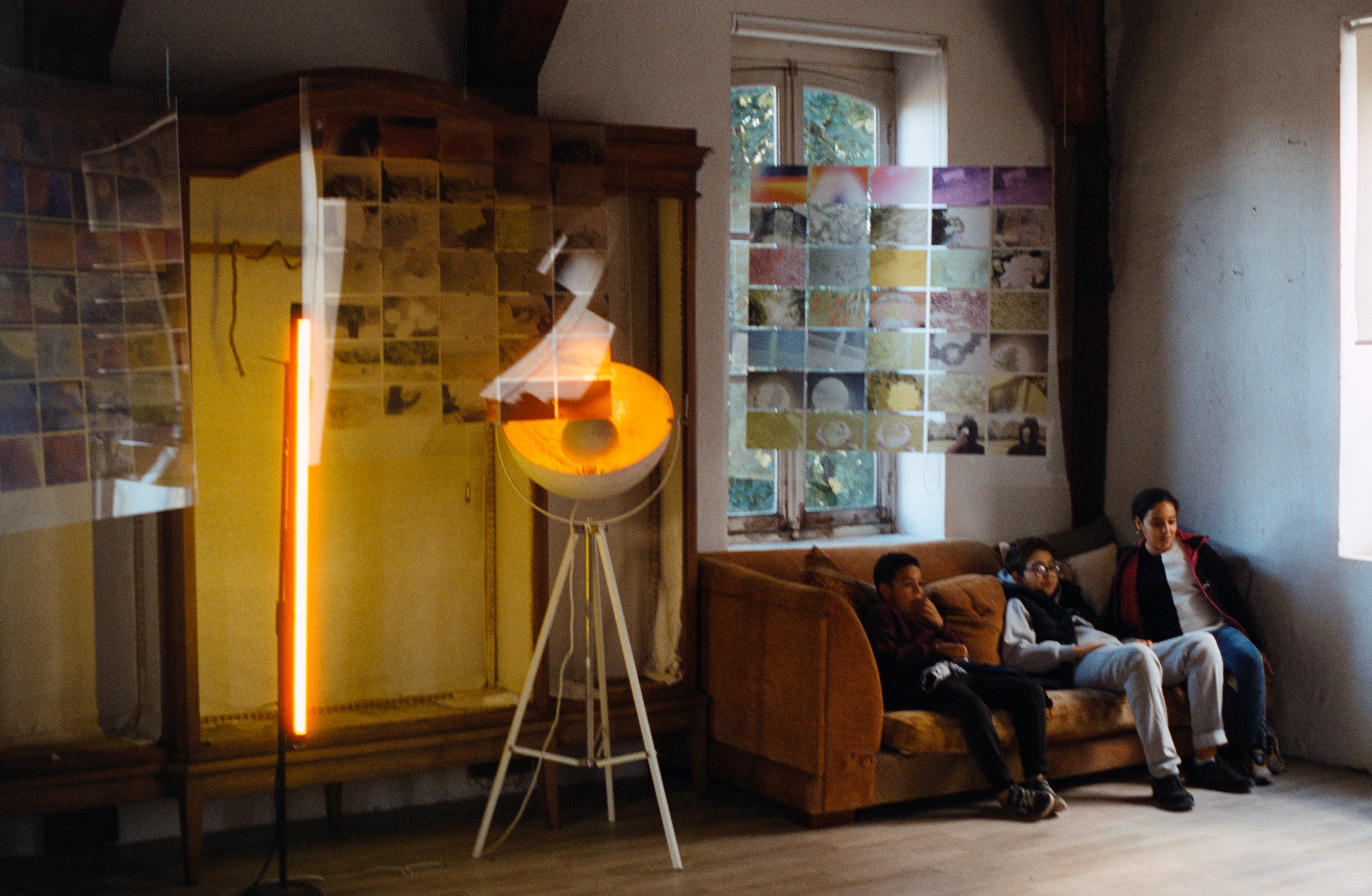
the territory enters the work
A neighborhood is not just a place to set up a workshop. Its uses, rhythms, languages, memories and transformations can change the project itself.
Research on light meets façades, passageways and the movement of the sun. Memory work meets family archives, but also silences, conflicting stories and ordinary objects. Research on images can meet a hand-drawn map, a recorded conversation or a textile material.
These encounters shift the initial questions. They can change a protocol, a scale, a material or the way a work is addressed. The workshops and co-creation processes are themselves living material: what is said, tried out and decided there feeds the work as much as what is made. The territory becomes a creative partner when this influence is possible, rather than when it merely serves as a subject to depict.
sharing the research, not copying a model
Artists arrive with a practice, a working history and a demand for form. Residents bring knowledge, experiences, gestures and ways of telling that are not interchangeable.
The residency seeks to connect these resources without asking participants to copy a style. Learning to look, draw, record or assemble is only part of the process. People also need to be able to propose a subject, discuss a choice, rework a piece and understand why a form is chosen.
Artists do not disappear into the collective. Their ability to propose, to compose and to hold a high standard remains decisive. But their proposal can be questioned and transformed by the contributions of others. In the same way, people do not become an anonymous group: their differences, refusals and points of view must remain perceptible.
from participation to composition
Producing a lot of images, texts or sounds is not enough to make a collective work. An essential step comes next: looking together, selecting, connecting and giving shape.
Which image opens the series? Whose voice do we hear? What does an edit reveal? What is left out? Should a map bring every point of view together or show the gaps between them? How can a personal object be shown without losing its story?
These decisions are artistic. They shape the construction of a story, but also the place of those who contribute to it. Sharing them, at explicit moments and in explicit ways, allows participation to genuinely influence the final form.
Collective creation therefore does not require constant unanimity. It calls for a framework for discussion, clear responsibilities and the possibility of understanding the choices.
renewing forms: concrete operations
Renewal does not come from simply adding several media. It can emerge when a way of working meets a situation that transforms it.
Translating. Spoken words become text, a memory becomes a drawing, a photograph moves onto a transparent material. Translation forces a choice about what is kept, what changes and what resists.
Assembling. Archives, contemporary images, objects and voices take their place in a single composition. Their relationship can produce a story that no single element carried on its own.
Layering. Layers make several timeframes or several versions of a story visible. The work does not have to resolve every contradiction.
Changing the address. A piece made in a workshop can become an installation, a film or an exhibition in public space. This shift involves the format, how people look at it and the way the story is told.
Making the protocol shareable. An individual line of research can become a proposal that other people take up and change. The point is not to simplify until it becomes thin, but to open up the possibility of acting.
These are the operations we try to make possible and to document.
mediation within the creative process
Cultural mediation takes many forms. In mOst residencies, we choose to treat it as a practice that operates at the heart of making.
A walk prepares an inquiry. A discussion helps choose a point of view. Watching images together helps people understand a frame or an edit. Preparing an exhibition opens up a reflection on what will be shown and on the place of each contribution.
The time for learning and the time for creating are then not entirely separate. Observing, trying, making mistakes, starting again, comparing and exhibiting are all part of the same experience.
This approach does not turn every encounter into a work. It makes it possible to think about the relationship with as much care as the materials: what spaces for speaking, what accessible gestures, what rhythms, what choices and what room for disagreement? Mediation becomes a condition for creation when it gives people a real hold on the process.
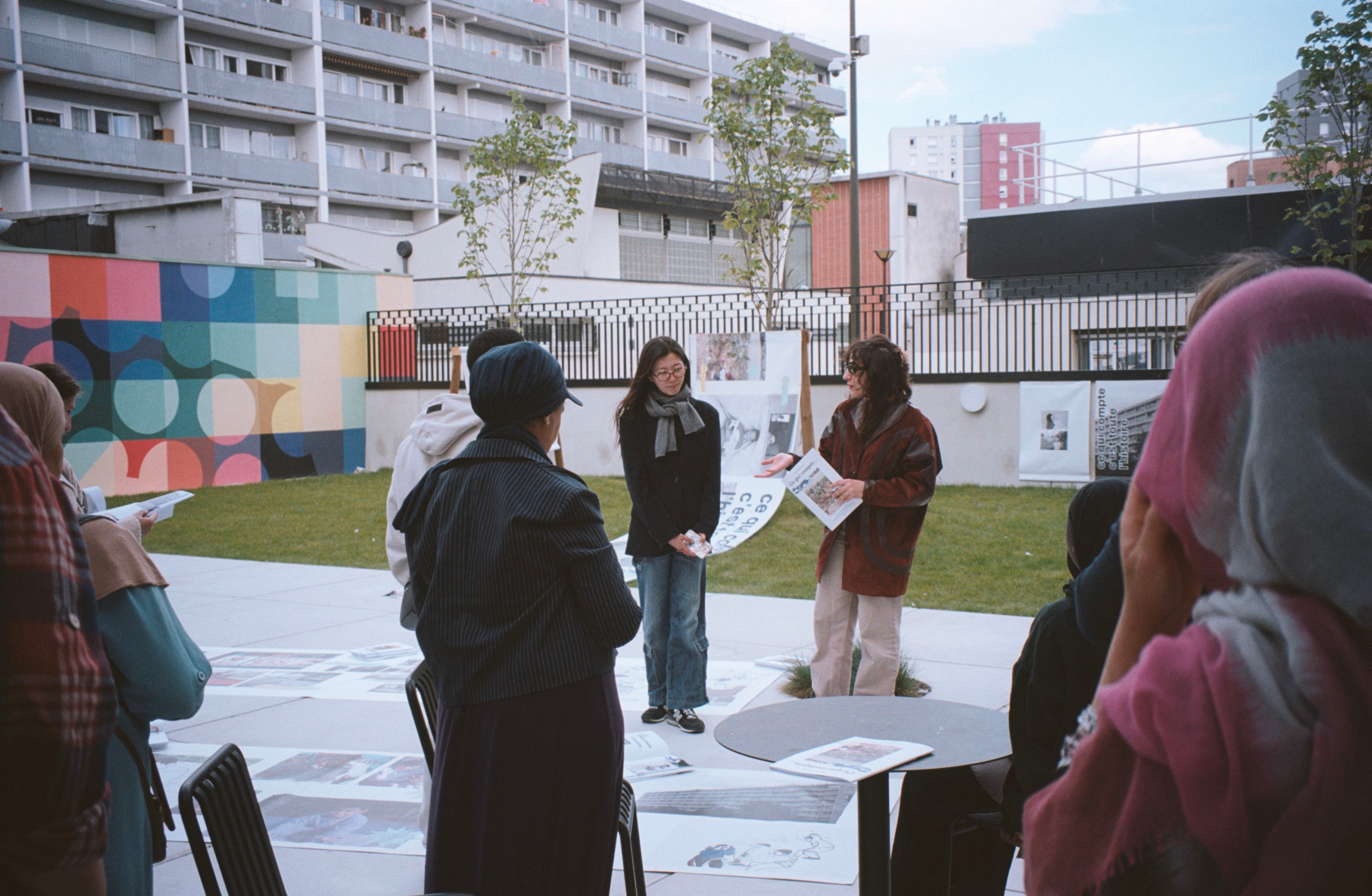
choices made in the residencies
Since 2023, mOst has run community-based artistic residencies in the Paris region, in Marseille and in Rio de Janeiro. Each one starts from a neighborhood and an artist’s research, and invents its own form. In 2024, a series of residencies brought Julie Rochereau, Virginie Gouband, Marie Mendes and Saïda Essafiry to Argenteuil, Bagnolet and Nanterre. For the residencies that have taken place, we describe what was done; for those being prepared in 2026 in Argenteuil and at Les Ruches, what their design documents propose.
argenteuil, 2023: going back to the origins of photography
With photographer Julie Rochereau, the children and young people of the Cité Champagne and the town center built their pinhole cameras from tin cans, developed their images in a darkroom set up for the occasion and let the sun reveal their cyanotypes. Going back to photography’s first gestures turned every image into an object made together. The exhibition “extension sauvage” was shown under the arcades of the Cité Champagne, then at the Musée Sauvage.
argenteuil, 2024: composing a mural, shifting the light
In Saïda Essafiry’s proposal, the mural is built from materials made with the participants: writing, photographs, drawings and recordings. The work does not stop at gathering contributions. It plans to look at them, connect them and compose a story from them.
Virginie Gouband’s proposal starts from another gesture: observing the light in the neighborhood, then acting on it with mirrors, filters and reflective surfaces. Filming and watching the footage make it possible to go back over the experiments before composing a film. Research on perception thus becomes a shared process of observation, intervention and editing.
aubervilliers, 2024: looking for the sea in the city
At Jean Moulin middle school, students from Côte d’Ivoire, Algeria, Egypt, Yemen, Mali and Afghanistan wrote down their memories of water, looked for what recalls the sea in Aubervilliers, then went to see it in Le Havre. Photographs, cut-out images and texts were put together in seven large collages: each person’s memory becomes a shared composition.
bagnolet, 2024: the neighborhood caught in blue
With Julie Rochereau, at La Capsulerie and La Noue, participants composed on glass plates, exposed them to light, developed them, then looked at their neighborhood through the blue of the cyanotype. Four cyanotypes on glass were printed at 120 × 80 cm, alongside two archive photographs of Bagnolet.
argenteuil, 2025: connecting life stories and the layers of the city
In Champagne and Val Nord, Laura Ben Hayoun and Dohyeon Eom’s residency brought two scales into dialogue: the life stories of people who came to the city over the years, and Argenteuil seen as a city made of layers that settle and change. Walks, visits to apartments, gathering stories and exploring archives connected personal memory and collective memory.
35 mm and medium format film photography, Super 8, drawing, writing and editing brought out correspondences between fragments of lives and fragments of the city. The public presentation traveled from Champagne to the Musée Sauvage, the Robert-Desnos media library and the Val Nord plaza, so that it existed in everyday places as much as in cultural venues.
marseille, 2025: memory through sound and drawing
At the La Maurelle community center, with Maymouna Baradji and Myriam Rabah-Konaté, the neighborhood’s memory was worked through recording and drawing. Sound gathers voices, atmospheres and fragments that don’t always come through images; drawing recomposes, brings back what is no longer there and opens a space for imagining. The children of Les Ruches also met, through images, the children of the T.L. in Rocinha and the photographer Fotogracria: “la galerie des ruches” brings the two neighborhoods together in fifteen panels.
melun, 2025: imagining the future of the plaza
On the Almont plaza, with La Boussole, Au Milieu and Gygo, film photography, sound recording, video, drawing and sensory maps were used to imagine the redesign of the plaza from residents’ habits and wishes. The maps fed into where the vegetable gardens and temporary installations went, and the exhibition “dalle, mon futur” was shown outdoors on the plaza and at La Boussole.
rio de janeiro, 2025: what if the favela were the museum?
At the top of Rocinha, on the T.L. lot, the photographer Fotogracria and the neighborhood’s children ran photography and art direction workshops. Participants named their works and chose the stories they wanted to tell. The exhibition, which mixes their images with the artist’s, was pasted up all across the favela.
argenteuil, 2026: sending traces to the future, telling through materials
With “Capsules du futur,” Maymouna Baradji proposes collecting and inventing traces of the neighborhood to send them to other people and other times. Drawings, images, texts, objects and layers of plexiglass make it possible to think about memory and imagination together.
“Cœur d’hibiscus,” with Massabielle Brun, starts from dyeing, fabric and an object chosen by each participant. The gestures of making meet portraits and family archives. The work does not just depict a story: it gives it a material, a use and a way of being shared.
These two paths are designed for the Champagne and Val Sud neighborhoods. Putting them in dialogue raises a question of composition: how can timeframes, objects and images hold together without erasing what makes each one unique?
drancy, 2026: a housing estate told by the people who live there
At the Cité du Nord, built to house the rail yard workers, the work with Myriam Rabah-Konaté settled for several months at the municipal community center, one conversation after another. Residents approved the photographs and decided what would be told, in what order and how far. Their disagreements about what the estate has become can still be heard in the photographic and sound exhibition “trains de vie.”
rio de janeiro, 2026: ten views on film in maré
Born from the meeting with Arteviana, an artist from Maré, the project handed film cameras to ten young people from the neighborhood. Each image is titled and commented on by the person who took it, in their own language and register. The prints were first seen where they were made, pasted on the walls of Maré.
les ruches, 2026: making the neighborhood’s layers heard and seen
The Les Ruches proposal sets out a residency built on layered memories: institutional archives, personal archives and traces of the present.
Maymouna Baradji’s visual and mapping research is in dialogue with Myriam Rabah-Konaté’s inquiry, listening and writing. Drawings, transparencies, maps, photographs, voices and soundscapes are imagined as parts of a shared proposal.
The form does not try to unify every memory. It can keep the gaps, absences and contradictions, and make several ways of experiencing the same territory perceptible.
supporting artists, opening up practices
Creating with a group is not a matter of running a workshop prepared in advance. It means being able to open up a line of research, welcome unexpected contributions, adapt gestures, share some decisions and turn the gathered materials into a demanding proposal.
mOst supports this process. Depending on the project, the work covers the context, partners, protocols, production resources, teaching, editing and public presentation.
For emerging artists as well as for more experienced ones, the residency can become a space to try another scale of work, encounter new materials and experience a way of composing with others. We do not assume this shift in advance: we try to give it the right conditions and to keep a record of it.
a shared work does not erase rights
The relationship does not give access to everything. A personal archive, an image or a statement can remain private. Taking part in the work does not oblige anyone to be photographed, quoted or publicly identified.
Sharing choices must include how the works will be shown, credited and kept. It must also recognize that people do not all occupy the same position or have the same power to decide.
We use the words author and co-author to describe an active role in stories and forms. The credits and conditions for sharing each work must be set out in context, not automatically inferred from the word “collective.”
exhibiting is still part of the work
An exhibition is not just a moment of recognition. It requires new work: choosing formats, scales, an order, relationships between images, listening spaces and a place for texts.
Returning to the neighborhood lets the works meet the people who made them possible. Showing them elsewhere can open other readings, as long as their context and credits are kept.
When people wish to and conditions allow, they can also present their work, explain a choice or talk with visitors. The public presentation then connects the work, sharing knowledge and hospitality.
what we seek to renew
We do not claim a method that would produce the same effects everywhere. We look for situations in which the encounter acts on the creative work: on its materials, its protocols, the place of its authors and the ways of making it public.
A residency is all the more interesting when it lets these shifts be recognized: an attempt taken up again, a question reworded, a form changed, an edit discussed or a new line of research opened.
Working-class neighborhoods are not just places to bring art to. They are places where forms are sought out and made.
- explore the community-based artistic residencies
- learn how we support artists
- see the projects and exhibitions
Sources: design documents for the community-based artistic residencies “RAP Argenteuil 2024” (pp. 2 to 5), “résidence argenteuil 2026” (pp. 2 to 6) and “résidence les ruches 2026” (pp. 2 to 7), mOst. The residencies from 2023 to 2026 are described from mOst’s 2025 activity report and the project pages.